Pacer Support Guide · Part 16 of 33
Pacing on Slopes: The Equal-Power Bridge Strategy
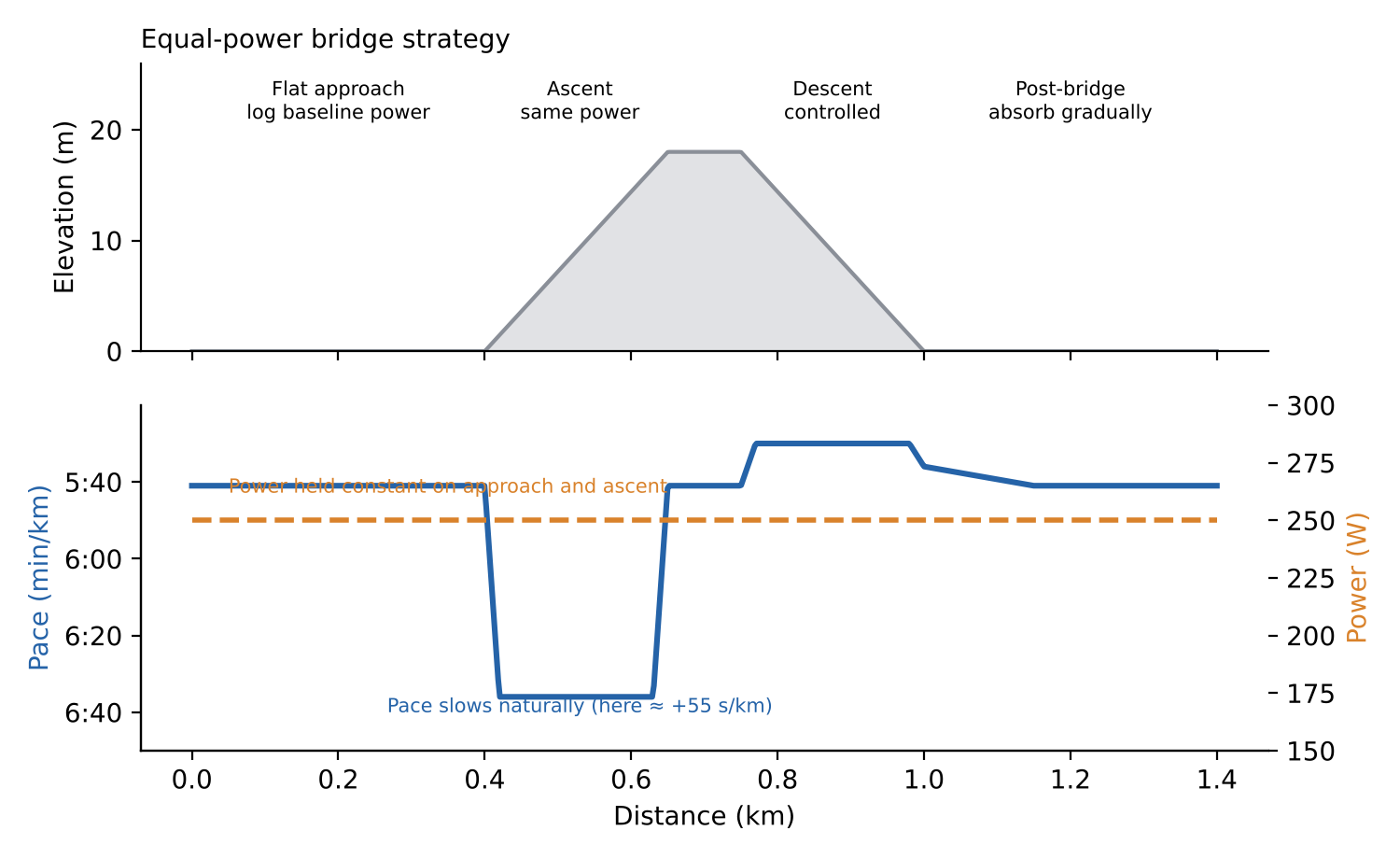
Don’t attack the hills. Hold the same power on the ascent, let the pace drop naturally, and absorb the difference after the bridge.
 Marcel Lennartz
1 min read
Marcel Lennartz
1 min read
Power-meter bridge and incline strategy#
Runners often attack hills, causing their effort to spike and depleting glycogen stores early. Downhills, in turn, are frequently run too aggressively, causing eccentric muscle fatigue that is paid for later in the race.
We therefore profile the key bridges and inclines of the course with a running power meter to establish grade-adjusted pace targets.
The protocol#
- Flat approach: run at a steady baseline pace and note your baseline running power (W), for example on the flat road about 200 m before the bridge.
- Ascent: hold the same power output and let your speed drop naturally. The resulting slowdown gives the exact pace reduction pacers must apply on that incline.
- Descent: increase speed comfortably to make use of gravity, without over-striding or pounding the legs.
- After the bridge: time lost on the ascent does not need to be recovered immediately on the descent; absorb it smoothly over the next few hundred metres of flat road.