
Pacer Support Guide · Part 17 of 33
Pace Corrections: The Unprogrammed Final Segment
In the final 2–5 km of a session no pace is given. Work out the required pace on the run with four simple calculation steps.
 Marcel Lennartz
1 min read
Marcel Lennartz
1 min read
Real-time mental arithmetic#
During the final 2–5 km of a training session, no segment pace is provided and pacers must not calculate it in advance. Before entering the final segment, the pacer works out the required pace on the run, using mental arithmetic. This builds the tactical awareness needed to correct any deviation and to close the session with a clean, controlled negative split.
Calculation steps#
- Deviation per km = current average pace − target average pace
- Total deviation = deviation per km × distance completed (km)
- Adjustment per km = total deviation ÷ remaining distance (km)
- Required final pace = target average pace − adjustment per km
Worked example#
| Step | Calculation | Result |
|---|---|---|
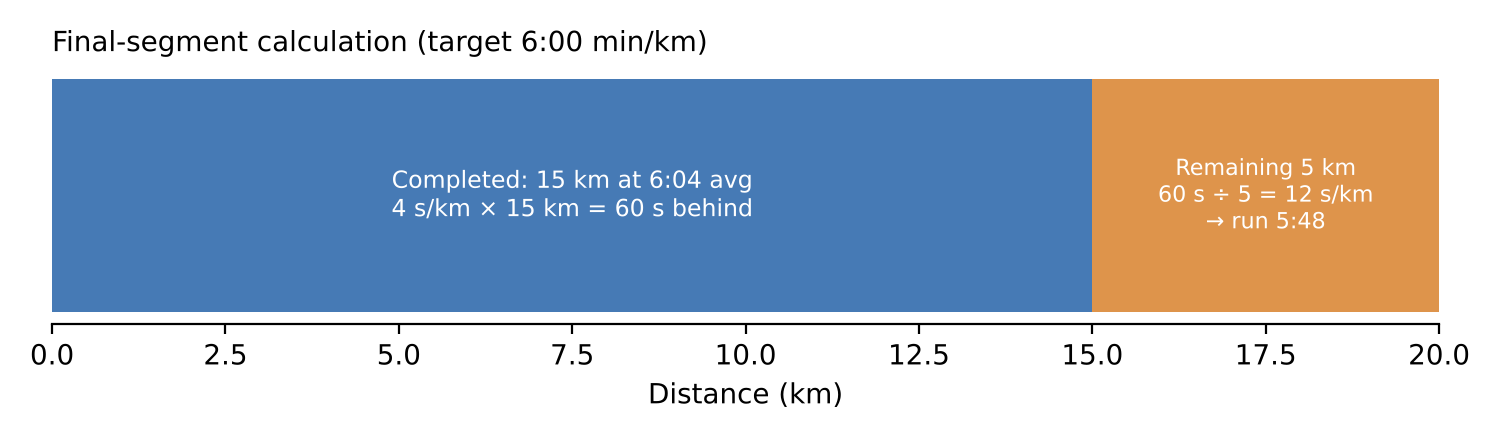
| Situation | Target 6:00 min/km; at km 15 (5 km remaining) the average pace is 6:04 min/km | |
| 1. Deviation per km | 6:04 − 6:00 | +4 s/km (behind) |
| 2. Total deviation | 4 s/km × 15 km | +60 s |
| 3. Adjustment per km | 60 s ÷ 5 km | 12 s/km faster |
| 4. Required final pace | 6:00 − 0:12 | 5:48 min/km |
If you are ahead of schedule the deviation is negative, and the same steps produce a final pace slightly slower than target.