
Pacer Support Guide · Part 10 of 33
Core Training Principles
Pacing is the art of energy management, environmental adaptation and tactical control. Every training session follows four foundational rules.
 Marcel Lennartz
1 min read
Marcel Lennartz
1 min read
Our training methodology is designed to develop pacers who perform to the highest standard for non-elite runners. Pacing is not simply running at a constant speed; it is the art of energy management, environmental adaptation and tactical control.
Through a structured, multi-faceted training programme, we prepare pacers to deliver smooth, predictable and confidence-inspiring execution for the runners who follow them on race day. This article sets out the principles that apply to every training session; the following articles describe the specific skills each session develops.
Four foundational rules#
Every training session follows four foundational rules:
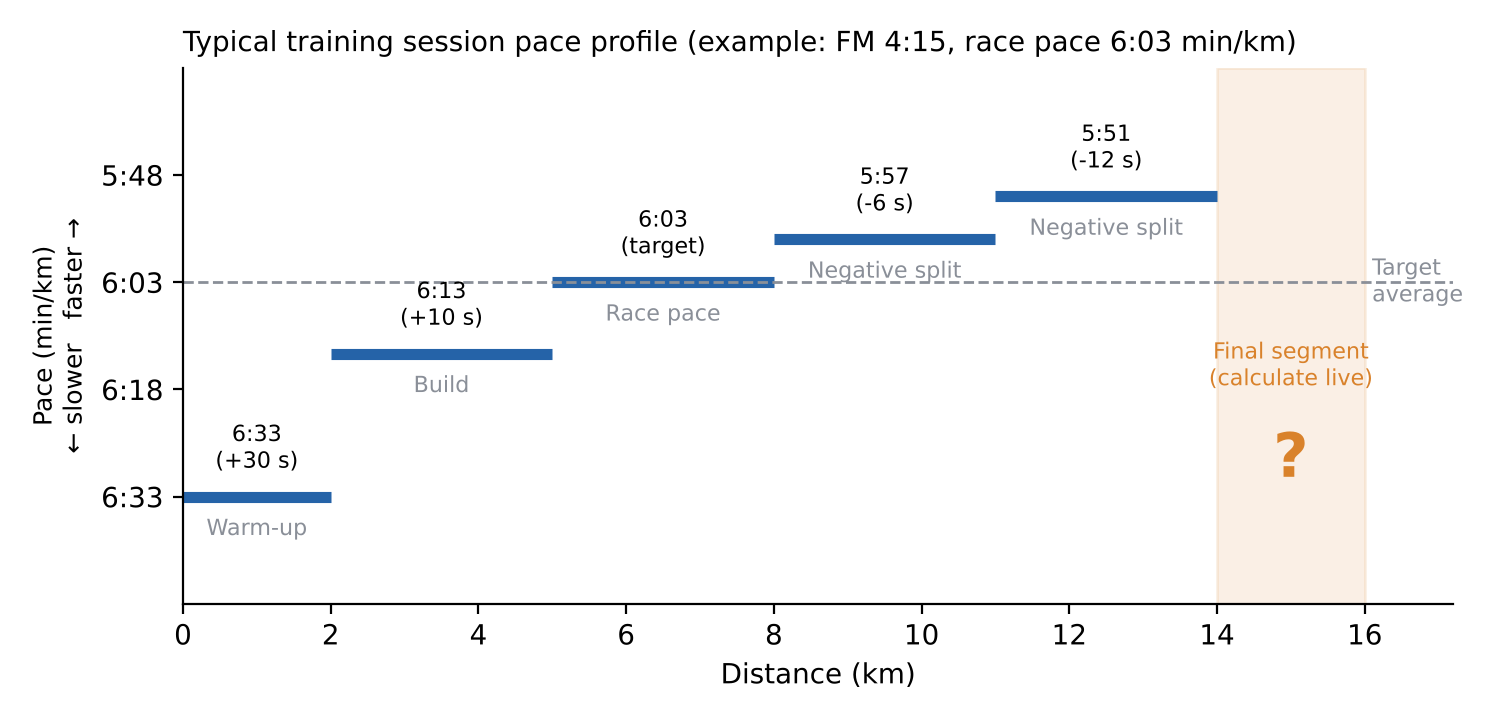
- Controlled warm-up (first 1–2 km): every session starts deliberately slower than target pace. This allows the body to settle in without burning energy early – exactly the start your runners will need on race day.
- Overall negative split: every session is structured so that the second half is run faster than the first.
- No pre-programmed workouts: workouts are never loaded into a GPS watch. Pacers execute the plan from memory and monitor their own performance manually. This rule applies to training; on race day tools such as PacerPro may be used under the conditions set out in Garmin PacerPro.
- Target average-pace accuracy: the objective is to finish the session at exactly the required overall average pace (min/km, rounded to the second), not to reach a particular clock time at a finish line. Each segment should be run within 1 s/km of its target.
Next: how every segment target is expressed as a relative pace offset.