
Pacer Support Guide · Part 15 of 33
Adjusting Pace Smoothly: The Inverted Interval Session
Abrupt speed changes cost your runners energy they need later. Learn to return to schedule gradually — and how fast a race-day correction may be.
 Marcel Lennartz
2 min read
Marcel Lennartz
2 min read
Dynamic course corrections – the “inverted interval” session#
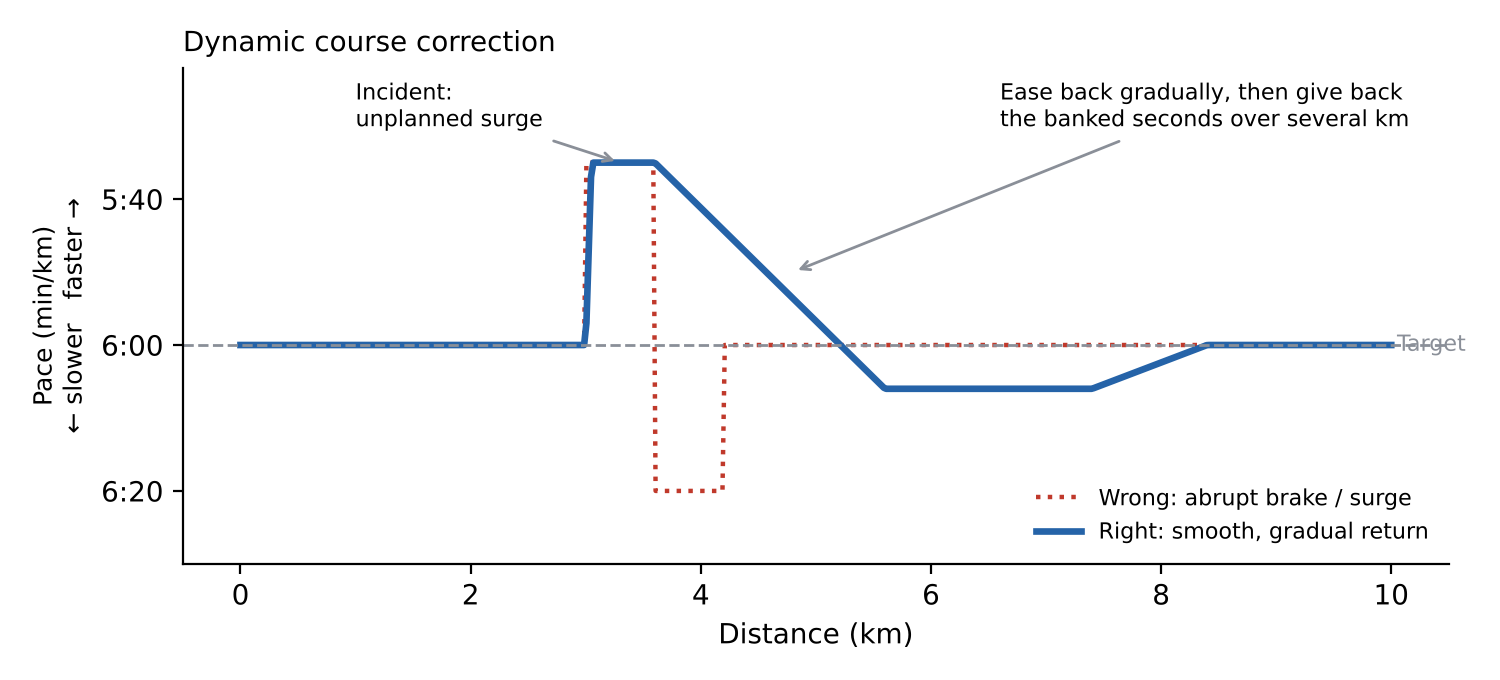
Pacers naturally tend to surge when excited, or to drift off pace because of GPS inaccuracies or fatigue. Abrupt changes in speed are costly for the runners who follow: every sudden acceleration or braking action wastes energy they will need later in the race.
In this session we introduce unexpected “intervals” that force the pacer significantly above or below target pace. The pacer must then return to schedule through a gradual, smooth correction.
- Over-speed recovery: when ahead of schedule, ease back gradually rather than braking hard, then give back the banked seconds over the following kilometres.
- Under-speed recovery: when behind schedule (for example after a delayed start or a congested water station), regain the lost seconds in small increments over several kilometres rather than with a sudden surge.
Rule of thumb: how fast to correct#
On race day, keep any correction within about 5 s/km of the planned segment pace. If the gap is larger, spread it over more kilometres rather than increasing the correction. For the runners behind you, a small change is barely noticeable; a large one costs energy they cannot spare.
| Gap to schedule | Correction rate | Distance needed |
|---|---|---|
| 10 s | ≈ 3–5 s/km | 2–3 km |
| 20 s | ≈ 4–5 s/km | 4–5 km |
| 30 s | 5 s/km | 6 km |
| 60 s | 5 s/km | 12 km |
- Correct early: a deviation of 2–3 seconds noticed at a km marker is cheap to fix; the same deviation ignored for 10 km becomes a problem.
- Never correct on a bridge: follow the bridge plan and absorb any difference on the flat road afterwards (see pacing on slopes).
- Late in the race: in the final kilometres runners have the least energy to spare. If you are behind schedule late in the race, accept a few seconds of difference at the finish rather than forcing your group into a hard surge.