
Pacer Support Guide · Part 19 of 33
Team Formation and the Role of the Team Leader
One leader front-and-centre, support pacers on the flanks — and why the team leader is not the best runner but the most consistent one.
 Marcel Lennartz
2 min read
Updated
Marcel Lennartz
2 min read
Updated
Team formation#
Rehearse the same formation you will use on race day: the team leader at the front, setting the pace, with two support pacers slightly behind, one on each flank.
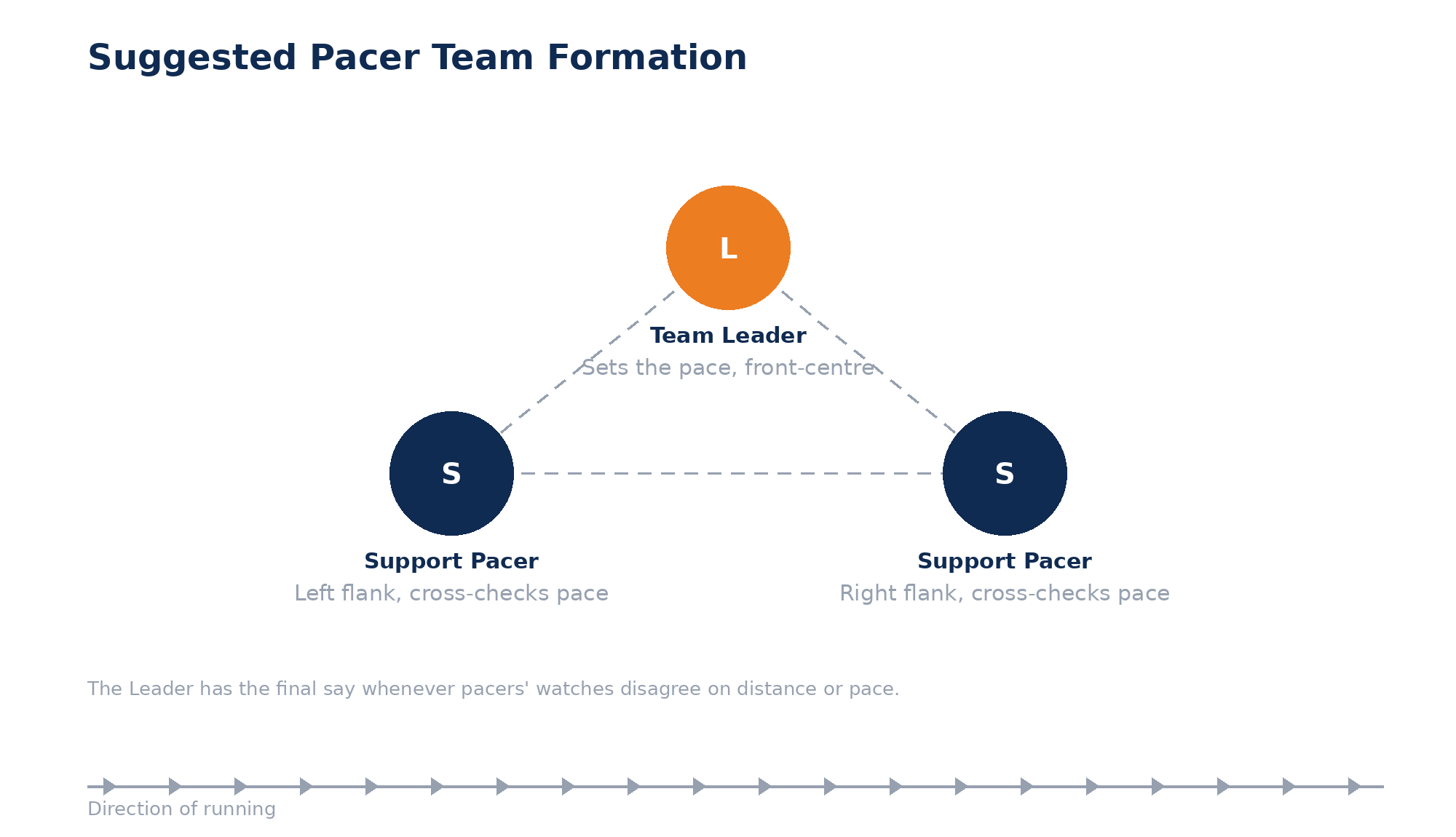
- Leader: runs front-and-centre and is the primary reference for pace decisions.
- Support pacers: run slightly behind and to each side, cross-check their own watch against the leader’s pace, and watch for runners who need help.
- Team size: three to four pacers per finish-time group.
- Lead pacer rotation: in group sessions, leadership rotates by segment. Each pacer leads a designated part of the run, so that every team member is comfortable at the front and can take over at any moment on race day.
- Team cohesion: practising together ensures seamless handovers and consistent messaging to runners on race day.
The importance of the team leader#
Every pacing group has one team leader. The team leader is not the “best runner” of the group, but the pacer with the most consistent pace discipline and the calmest judgement – qualities that are visible in the training results.
| Phase | Team leader responsibilities |
|---|---|
| Before race day | Confirms that every team member has the strategy plan, shirt and bib; agrees roles, calls and hand signals; appoints a deputy leader. |
| At the gathering point | Checks that all team members have arrived and that backpacks, flags and watches are ready; reports absentees to the pacer coordinator immediately. |
| During the race | Sets the pace at the front according to the strategy plan; is the main point of contact for runners’ questions; receives pace checks from the support pacers; takes the final decision on any pace adjustment after a quick team check (see when watches disagree). |
| Problems | Decides how the team handles a pacer who must leave (see if you can’t continue) and makes sure the group continues with clear roles. |
| Last kilometres | Decides, together with the team, whether a team finish or a faster final push is appropriate (see the last kilometres). |
| After the race | Makes sure flags and backpacks are returned and FIT files are submitted. |
Handover: if the team leader has to stop, the deputy leader takes over immediately – no discussion is needed on course. The lead-pacer rotation used in training ensures that every pacer is ready to lead.
Support pacers are not passengers. They monitor pace and distance, keep an eye on the runners behind the group, collect drinks, and tell the leader early when something is wrong.